Section 03 of 03

How to get it back

Reverse the playbook

The grayscale effect

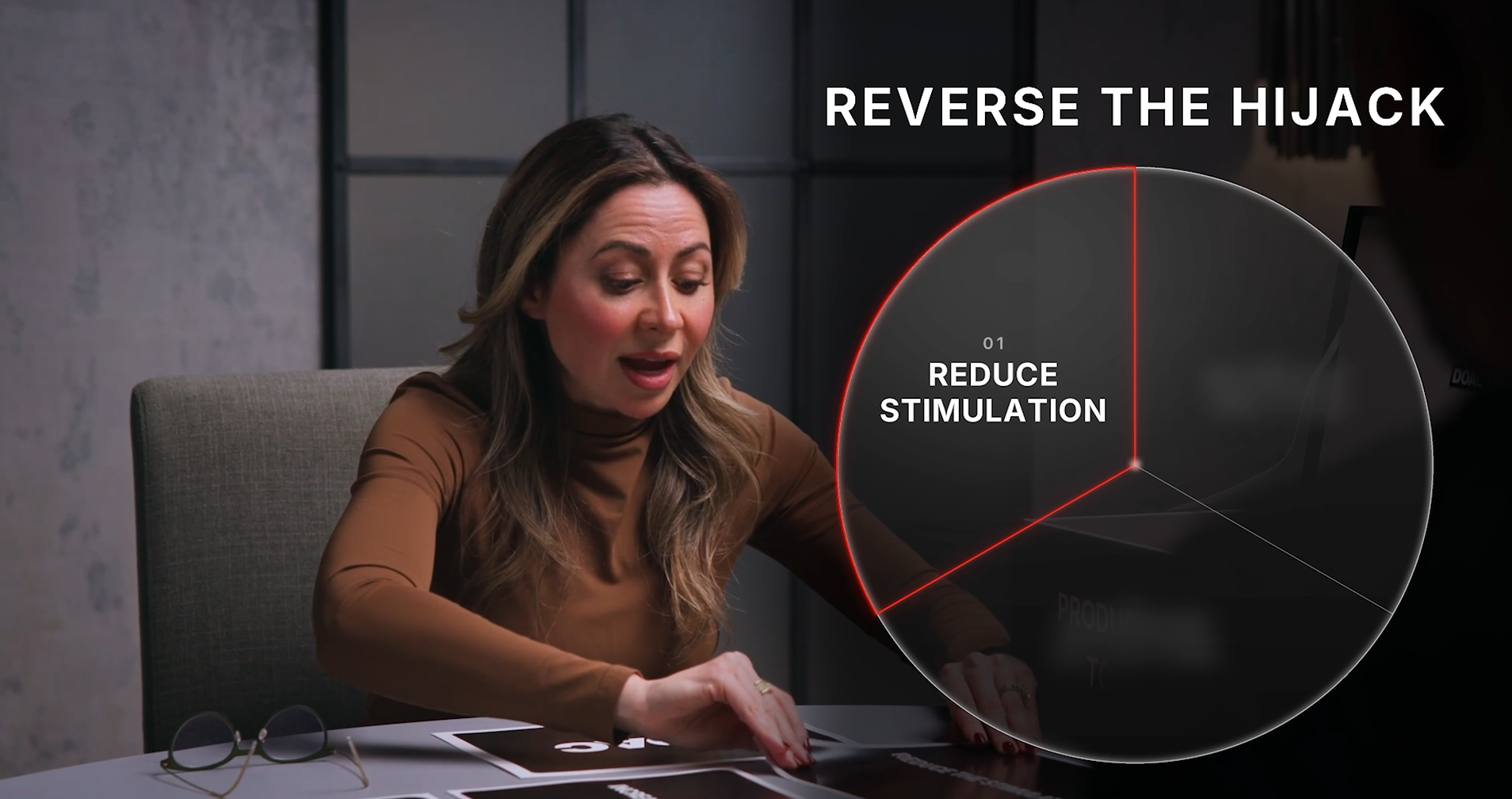
Dr Sahar Yousef, speaking beside a graphic captioned Reverse the hijack: 01, reduce stimulation.

“I think we can use reverse neuroscience to reverse this entire thing. If they increase the stimulation, as we talked about before, you reduce it.

And the ways in which you reduce the stimulation, one, if you keep your phone in gray. So, literally going into something like grayscale makes the phone less neurologically stimulating. So, it’s a heck of a lot easier for you to actually get off your phone.”Watch the clip · 43:45

Dr Sahar Yousef

Independent fact check and further reading Grayscale works, but the measured effect is 20–40 minutes a day, not an hour.

And the hour a day in the clip?

Independent fact checkOctober 2026

That one has not been published

The hour comes from Dr Yousef’s own lab, where working professionals kept their phones gray for three weeks. The independent fact check commissioned for this episode could not find a peer-reviewed report of that study, so it cannot be checked alongside the others. What the published work supports is twenty to forty minutes a day. How long the effect lasts has not been studied by anyone.

Does taking the color out change anything?

Peer-reviewed study2020

Students on grayscale spent about 39 minutes less a day on their phones

Around two hundred American college students switched their displays to gray and kept them there. Daily screen time fell by roughly two-thirds of an hour against their own baseline. It is the largest reduction in the handful of studies that have tested this directly.

Does it stop you reaching, or just shorten the visit?

Peer-reviewed study2023

A week in gray cut use by twenty minutes a day, but not the number of pick-ups

A pre-registered trial found about twenty minutes a day less, with the steepest drops on the image-heavy apps — which is what you would expect if color is doing the pulling. How often people unlocked the phone did not change at all. Gray shortens the visit. It does not stop you arriving.

How to actually turn it on Step by step for your phone — all the time, on a schedule, or only in certain apps.

iPhone

Do this bit first. Settings → Accessibility → Accessibility Shortcut → tick Colour Filters, and nothing else. A triple-click of the side button now turns gray on and off from anywhere. Tick a second thing and the triple-click opens a menu instead, which is slower when you want color back in a hurry.

All the time

  1. Settings → Accessibility → Display & Text Size → Colour Filters.
  2. Turn Colour Filters on, then choose Grayscale.

On a schedule

  1. Open Shortcuts → Automation → +.
  2. Choose Time of Day, set your evening time, and pick Run Immediately.
  3. Choose New Blank Automation and add the action Set Colour Filters, left as Turn On.
  4. Build a second automation the same way at your morning time, with the action set to Turn Off.

Focus modes can’t do this on their own — grayscale isn’t one of the things a Focus can switch. Shortcuts is the only route.

Only in certain apps

  1. Shortcuts → Automation → + → App → Choose → pick the apps.
  2. Leave Is Opened ticked, choose Run Immediately, then Next.
  3. Add the action Set Colour Filters, Turn On.
  4. Build a second automation with the same apps, this time Is Closed, with the action set to Turn Off.

Both halves are needed. Switching straight from one app to another isn’t always counted as closing the first, so an automation built only on “Is Closed” will miss cases and leave you gray.
Worth knowing: you can run this backwards instead — gray everywhere, and let Camera, Photos and Maps bring the colour back when you open them.

Worth knowing, whichever phone you have

  • It changes the screen, not the phone. Photos and video still record in full colour — only the preview looks gray.
  • It is not a blue-light filter. The colour goes, the brightness doesn’t.
  • Some things get genuinely harder: maps, charts, colour-coded calendars, anything you edit for colour. If you rely on colour to tell things apart, this may not be for you, and that is a reasonable place to stop.
  • A web version of an app won’t be caught by a rule that watches the app.
  • Menu names move between phone models and software updates. If a step doesn’t match what you see, search your settings for colour.

Paths checked 11 November 2026. Vendor guides: Apple · Samsung · Google.

One thing at a time

The switch cost

Proving the multitasking myth

Read it instead

Lightly edited from the recording for reading. Square brackets mark what happens off the mic.

Bartlett: “One of the things I’m terrible at … I think multitasking is, I’ve always believed it is a thing, it is a more productive solution. And I consider myself to be a very proud context-switcher. But then I heard about this exercise that you do to prove to people that multitasking is a myth. … What is this thought experiment or task that highlights the myth?”

Yousef: “It’s so simple too, by the way. So what you’re going to do for me, Steven, is draw two lines on that piece of paper. … What we are going to attempt to do is, using the most — I would say ridiculously oversimplified — task, this is insanely easy for you, but what we’re attempting to do is get a sense of what we call your switch cost. Your switch cost is the amount of time and energy that you essentially waste every single time you switch your attention from A to B to C, and so on.

Biological law. Another one. There’s no free lunch. Every single time you do something with your biological being, you pay for it.

… What you’re going to write on the top line is, ‘I’m a great multitasker.’ And then at the bottom line, you’re going to write the numbers 1 through 20. And you will do this as fast as you possibly can, and I will time you.”

[Bartlett writes the sentence, then goes back and writes the numbers. Thirty-one seconds.] Watch this bit · 2:01:40

Yousef: “Beautiful. I want you to do this one more time. This time the way in which you will arrive will be a little different. You’re going to alternate. So you’re going to start at the top line and you’re going to write the letter I. You’re going to drop down to the bottom line, number one. Back up to the top line, letter A. Down to the bottom line, number two. … So on and so forth until you finish both lines.”

Bartlett: “Do you know what? If I get to thirty-one seconds, just tell me and I’ll stop.”

[He alternates between the two lines. At thirty seconds he is on number eight.] Watch this bit · 2:03:15

Bartlett: “That is 40% of the speed as when I just focused. Said differently, 60% slower when I was multitasking between numbers and letters. So on a daily basis, theoretically, I’m losing perhaps 60% of my productivity just by switching between two different types of tasks at once.”

Independent fact check and further reading The switching cost is well established; the 60% is illustrative, not measured.

So is the 60% a measurement?

Independent fact checkOctober 2026

The mechanism holds up. The number is a demonstration

One person, one attempt, nobody blinded — and the alternating round always comes second, by which point the sentence is half committed to memory and the practice works in its favor. He also loses count partway through. The independent fact check rates the switching cost itself as well established and the 60% as illustrative rather than measured, and adds that writing letters and numbers is a long way from what switching between real pieces of work actually involves.

Is there really a cost every single time?

Research review2003

Preparation shrinks the cost of a switch. It never clears it

Decades of reaction-time work point the same way: alternating between two tasks is slower and less accurate than repeating one, and the penalty is paid on every switch. Telling people a switch is coming reduces it. It does not remove it — a residual cost survives even after several seconds of warning. Per switch the figure is tens to hundreds of milliseconds, which is small enough to be invisible and frequent enough to matter.

Workbook approx. 3 min (and a pen)

Try it on yourself

See how your own performance compares with Steven’s — are you a better multitasker? You can save the results to your workbook and come back to the concept later.

Workbook approx. 3 min

Try it on yourself

Grab a pen and some paper. This one is worth doing rather than reading about — the gap between the two rounds is more convincing in your own handwriting than in anybody’s statistic.

  1. Round one — one thing at a time

    Draw two lines on the paper. Write this sentence along the first line, then go back and write the numbers along the second:

    I am a great multitasker. 1 2 3 4 5 6 7 8 9 10 11 12 13 14 15 16 17 18 19 20

    Finish the sentence completely before you start the numbers. Time yourself.

  2. Round two — switching

    Two fresh lines. Same sentence, same numbers — but alternate between them. One letter, then one number, then the next letter, then the next number:

    I  ·  1  ·  a  ·  2  ·  m  ·  3  ·  …

    Keep going until both lines match round one exactly. Time yourself again.

Each round times itself, or type your own times straight in. Space starts and stops the round you’re on.


Kept in this browser, on this device. It won’t follow you to another one.

What you carry with you

Attentional baggage

Switching costs energy, not just time

Read it instead

Lightly edited from the recording for reading.

Yousef: “So you’re not only getting less done; energetically one is more expensive than the other.”

Bartlett: “You know what, it was way less enjoyable. It was painful. It really did remind me of how I’ve been working, because every time I went from one line to the other, I went from the letters to the number, I had to remind myself again of where I was with the numbers. … And then when I went back to the letters, I was like, where are we again with the letters? So there was a little bit of a gap there in me trying to figure out what came after the letter I, for example.”

Yousef: “By the way, there’s a name for that concept that you were just — you were feeling it. It’s palpable. It’s called attentional residue. I know it sounds gross.

I call it attentional baggage, because I find the visual that that creates better — meaning you carry into the next task all the baggage from the previous task, unless you close out. I say get cognitive closure. Close out the tab, so to speak, on your computer, and just be like, ‘All right, this I’m going to do.’ Clean up shop. Get cognitive closure. Close the box. Don’t carry one bag from one thing into the next thing. Try to as much as possible get cognitive closure.

When you multitask, one, you’re barely onboarding to the next task — you’re carrying shit from the last one. It’s taking you longer to actually finish anything. By the way, over two hours a day is the estimated average now for the average knowledge worker, just bouncing between screens and different tasks. I think it’s absolutely wild.”

“You carry into the next task all the baggage from the previous task, unless you close out. I say get cognitive closure.”

Dr Sahar Yousef

Independent fact check and further reading Well supported: the residue is real, and it costs accuracy and speed.

And the two hours a day?

Independent fact checkOctober 2026

That one is the hook, not a number to plan around

The switching cost is solid in the lab, where it is measured per switch in milliseconds. Turning that into hours lost across a working day is where it comes apart: field studies define and measure workplace disruption so differently that the independent fact check does not assess the two-hour figure directly, and calls the translation disputed. No source is given for it in the episode.

Is attentional baggage a real thing, or a good metaphor?

Peer-reviewed study2009

Leaving a task unfinished leaves part of your attention on it

Two experiments on people switching between work tasks. Performance on the new task suffered while attention was still on the old one — and simply being allowed to finish the first task was necessary but not sufficient to prevent it. What helped was time pressure on the first task: being pushed to a close let people disengage, and they did better on whatever came next. Yousef’s “attentional baggage” is her own name for the published term, attention residue.

Leroy, Organizational Behavior and Human Decision Processes, vol. 109

Read the study →

Deciding what gets through

VIP notifications

Choosing our interruptions with intention

Read it instead

Lightly edited from the recording for reading.

Yousef: “If you’re monitoring your inbox all day, and it’s constantly available to you, what’s your plan for having deep thoughts?”

Bartlett: “This is the rebuttal that I think me and my listeners will be thinking right now: ‘Yes but — what if something happens? I have my email open because maybe a big email comes in. Or I have my WhatsApp there because maybe my fiancée’s gonna tell me I need to let her in the house.’”

Yousef: “Fires, urgencies. I get it. … I call these, by the way, VIPs. These are VIP notifications and messages.

Can I paint a picture for you for a second? We figured this out for mail. If you have an extremely important package coming to your house, how do we deal with this in the mail system? Somebody knocks. It needs a signature. We’re not leaving this outside. Somebody needs to be home.

Knock, knock, knock. I’m going to come and get your attention. To me, that knock — you need to sign for this — is a notification. That’s the fire, right? And everything else, by the way, just gets shoved in the mailbox or left by the door.

This is what I advocate for. We are all, by the way, smart enough. We should respect ourselves enough truly to demand better than the default settings that our apps, our email, our phones come with.”

“I deserve better than the default. I am better than the default settings.”

Dr Sahar Yousef

Workbook approx. 6 min

Your default settings

Name the people your phone should always interrupt you for, and the noise you want to silence. Then decide what to do about it.

Workbook approx. 6 min

Your default settings

Yousef’s point isn’t that notifications are bad. It’s that your phone can’t tell the important package from the junk mail — unless you tell it. Start by separating the VIPs from the noise.

Part 1

Who are your VIPs?

The people who need to reach you whatever else is happening.

Your VIPs

What’s making noise?

Apps, inboxes and group chats that interrupt you.

What’s making noise

Part 2

Now decide how you’d like to manage your VIPs vs everything else. Below are some suggestions you can adapt to suit your needs, just fill in the blanks. Choose the ones you think will work and leave the rest — you can always come back later.

My phone is

Letting your VIPs through

  • When my phone is , I still want calls and texts to come through from .
  • Mute , except for messages from .
  • I want my inbox to stay quiet, except for emails from .
  • If the same person rings twice within three minutes, let the second call through — whoever they are.

Turning down everything else

  • Between and , the only people I want to hear from are .
  • No sound and no banner from . They can wait until I look.
  • Nothing on my lock screen from .
  • Mute . I’ll look when I choose to.
  • No dot on the icons for .
  • I want one delivery at instead of a stream all day, from .

Optional — a rule of your own

If there’s something you want that isn’t above, write it here in the same shape: what, when, who, and how.

A rule of your own

Your rules go to your workbook in your own words. Nothing to set up now — this is a list to try, not a pledge.

Kept in this browser, on this device. It won’t follow you to another one.

When you are at your best

The chronotype test

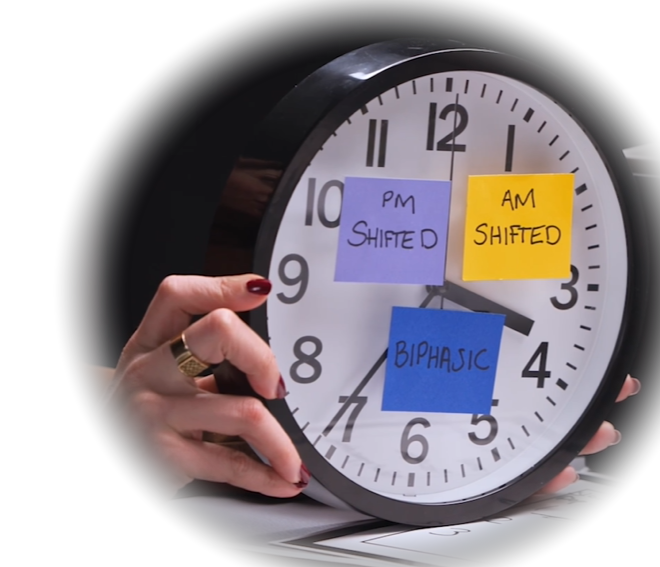
A wall clock held in one hand, three sticky notes on its face reading PM shifted, AM shifted and biphasic.

“The science of chronotypes will tell you the science of ‘when’. … Human beings do not share one circadian rhythm. … we don’t all share one rhythm of exactly the ideal time that we would go to sleep and wake up. These different circadian rhythms are in fact called chronotypes.

So your chronotype is your genetic biological ideal time. It’s essentially a profile of the hormones and your energy levels throughout the course of the day.”

Dr Sahar Yousef

12AM 6AM 12PM 6PM 12AM HIGH LOW HIGH LOW HIGH LOW
How focus shifts over the course of a day

About a quarter of people

Cortisol spikes first thing; energy peaks early and declines steadily across the day. The default working day is built around this group.

In this clip

Read it instead

Lightly edited from the recording for reading. Square brackets mark where each part begins, matching the chapters under the player.

[AM-shifted · 1:39:30]

Yousef: “There’s AM-shifted individuals — this is the science behind morning birds.”

Bartlett: “So people that like doing stuff early.”

Yousef: “Yeah. And again, it’s genetic and it’s hormonal. These individuals naturally, their cortisol levels spike really, really early in the morning. Some people are the 4:00 in the morning people. They’re the 5:00 in the morning people, 6:00 in the morning people. They are naturally AM-shifted. It’s not their fault necessarily.

And by the way, how do you know that you’re truly AM-shifted? Even if I keep you up until 2:00 in the morning — and let’s say I’m controlling things, you no longer have young children that are going to wake you up, you no longer have any meetings, nothing at all. I’ve put you in the best hotel in the world with the most comfortable bed, fully blackout. You can hear a pin drop. There’s nothing that would otherwise wake you, and you can sleep as long as you want. And I kept you up until 2:00 in the morning. Oh, don’t you worry. That pituitary gland is very strong. Your body knows when it’s 5:00 in the morning. It doesn’t even need to see light. It naturally will wake you up. So now you’re sleep deprived, but you have no choice.

So those people that naturally wake up at early hours of the day regardless of when they went to bed the night before — those are AM-shifted individuals, and it’s all about their cortisol levels first thing in the morning. That is about, by the way, 25% of the human population. It’s not the majority. My humble opinion is the world seems to be oriented around these people, right?”

[PM-shifted · 1:40:58]

Yousef: “Early bird gets the worm.”

Bartlett: “Everything starts — school started at 9:00 a.m., so you had to be up at 7:00. That’s part of the reason I hated school so much. I liked staying up really late.”

Yousef: “Same. Then you are likely the minority of the human population, like me. PM-shifted. Anthropologically, by the way, the only reason we imagine why people like you and me exist — because otherwise it’s somewhat dysfunctional.”

Bartlett: “Otherwise, yeah, it would be strange to have different sleep schedules and stuff like that.”

Yousef: “I can’t see in the dark. It’s somewhat dysfunctional that we’re awake all night.

But think about it this way. If you and I were in the same tribe, along with my team and your team, and we’re all, ‘Okay, we’re a village now together,’ and everybody went to bed at 10:00 p.m. and woke up at 6:00 a.m. — what would happen in the middle of the night when a competing tribe comes to slaughter all of us?”

Bartlett: “The night is the most dangerous time, isn’t it, for anybody? So you need some people that are awake, and then even in the morning you need some people that are. So you do need to stagger, in a tribe, the time in which people are highly functional, which makes evolutionary sense.”

Yousef: “You need a 24/7 team. You need to make sure someone’s always awake.

So you and I belong to a tiny subset of the human population. According to research from my lab, we’re at about 16% from what we’ve gathered around the world. So 16% of the human population is PM-shifted, meaning genetically we tend to be able to stay up quite late, and we can sleep in, and our energy levels rise as opposed to shoot up early in the morning and then linearly decrease as the day progresses.”

[Both types compared · 1:42:57]

Yousef: “AM-shifted people do their best focus, their best thinking straight away early in the day, and they just seem to lose steam as the day progresses. There’s no second wind for them, really. When you take a standardized test in my lab — let’s test your intelligence, your attention span, memory, all of it — when would you schedule that test? For AM-shifted people, they’re like, ‘Are you free at 7?’ Because they’re the best in the morning. For PM-shifted people like you and I, honestly, the afternoon.”

Bartlett: “In my younger years, oh my gosh, the evening. I do my best work like 9:00 p.m. on. It’s my clearest thinking, the most energized, the most clear-headed, up until the wee hours in the morning.”

Yousef: “It’s not super functional, but it’s genetic, and you can make use of it.

PM-shifted people also have a tendency to be the most artistic and creative.”

Bartlett: “There you go. Say that again. Look at the camera and say that again.”

Yousef: “Most artistic and creative.”

Bartlett: “I did not seem to get those. Whatever.”

[Biphasic · 1:43:49]

Yousef: “Then you have the vast majority of the human population, and those are people who are biphasic. Biphasic stands for the Latin — two phases, or two peaks. And these individuals wake up a little groggy, but within about 45 minutes to an hour they’re ramped up, off to the races. They’re feeling great. Two phases, or two peaks. So they peak once in the morning. They come down for the biggest afternoon dip, comparatively, of all three types, and then they will come back up for a second wind if they play their cards right. So those are the three chronotypes.”
Independent fact check and further reading The three types are standard, but the proportions shift with age — and it’s about half genetic.

And “your genetic biological ideal time”?

Independent fact checkOctober 2026

Substantially inherited, but not predominantly genetic

Twin and family studies put heritability at roughly 40 to 54 per cent. The rest is light, season, age and the social clock. The largest mapping study found 351 genetic variants across nearly seven hundred thousand people — and the group carrying the heaviest load of morning-type variants woke, on average, twenty-five minutes earlier than the lightest. Twenty-five minutes, not hours. The three types are real; the word genetic is doing more work in the clip than the evidence gives it.

Why would people differ at all?

Peer-reviewed study2017

In twenty days, a Hadza camp was never all asleep for more than about eighteen minutes

Thirty-three adults in a Tanzanian hunter-gatherer community wore activity monitors for twenty days. Across the whole period, the moments when every one of them was asleep at the same time added up to roughly a quarter of an hour. A median of eight people were awake at any point in the night, and older people woke earliest. The authors argue that spread-out chronotypes left the group less exposed after dark — an explanation that fits the data but is hard to test directly.

Samson, D., Crittenden, A. N., Mabulla, I. A., Mabulla, A. & Nunn, C. L. (2017) ‘Chronotype variation drives night-time sentinel-like behavior in hunter–gatherers’, Proceedings of the Royal Society B, 284.

Read the study →

Are evening people really the creative ones?

Peer-reviewed study2017

No overall link was found between chronotype and creative thinking

Tested on both divergent and convergent thinking, chronotype made no difference overall. One narrower effect did show up: late types did better on a word-association task when tested at their worst time of day rather than their best. Eveningness does track with imaginative and novelty-seeking styles, and with artistic groups — performance musicians skew late, art students say they feel creative after 10pm — but liking the work and the hours is not the same as scoring higher.

Simor, P. & Polner, B. (2017) ‘Differential influence of asynchrony in early and late chronotypes on convergent thinking’, Chronobiology International, 34(1), 118–128.

Read the study →

Workbook approx. 2 min

What’s your chronotype?

Work out when your own sharpest hours actually are — and when they are not. It saves to your workbook.

Workbook approx. 2 min

What’s your chronotype?

You might already have an idea which chronotype sounds most like you. Update your workbook with your answer and define your core hours.

If you know which one you are, select it from the list and continue. If you’d like to take Yousef’s own assessment, it’s free with the code DOAC at MyChronotype. Complete it and then come back here to record your result.

I am

Now identify your peak and trough hours. Rough is fine — go on an ordinary working day rather than your best one.

and

Kept in this browser, on this device. It won’t follow you to another one.